Showing posts with label sweden. Show all posts

Thursday, December 12, 2013

Countdown to Christmas - St. Lucia Day Recipes and Recollections

Recipes and Recollections - St. Lucia Day

St. Lucia Buns - Christmas celebrations in Sweden begin with the feast of St. Lucia on the 13th of December. Lucia is the patron saint of light and she is honored on this day. In homes that still observe the feast, the eldest daughter awakens early, dons a white garment sashed in red and places a crown of laurel that holds 4 candles upon her head. Legend tells us that Lucia, whose name means light, placed candles in a wreath she placed on her head in order to free her arms to carry bread she was smuggling to Christians hiding in the catacombs. These days the daughter leads a musical procession with her younger siblings in tow and serves the family special buns called lussekatt for their breakfast. The saffron flavored buns are usually shaped like the figure eight and are topped with raisins at either end of the spiral. The children may, if they wish, wear their costumes to school on this day. Winter months are dark in Sweden and the candles in Lucia's crown symbolize the light of faith and the promise of the sun's return. Read More...


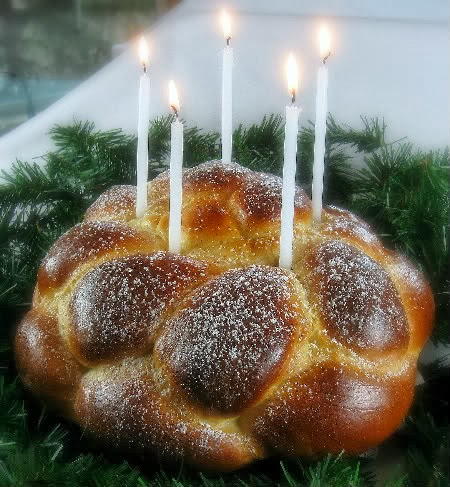
Santa Lucia Crown - St. Lucia is an Italian saint who has been "adopted" by the people of Sweden. Christmas celebrations in Sweden begin on her feast day, which is the 13th of December. Prior to the introduction of the Gregorian calendar, that date was the shortest day of the year and in some regions of Scandinavia the sun didn't rise at all. Lucia is the patron saint of light, and legend tells us she wore a wreath of candles on her head to free her arms to carry bread to starving Christians hiding in the catacombs. The man she was to marry denounced her for assisting the poor and as a punishment she was blinded and set afire. The flames, however, didn't touch her and it took a stab wound to the heart to finally kill her. It is said that Lucia regained her sight just before her death. She is, to this day, revered as the patron saint of the blind because of her association with light. Her place in Swedish legend was earned because farmers in the middle ages believed she walked across a lake to deliver armloads of bread to starving members of their villages during a famine. They reported her path across the water was illuminated by the crown of candles she wore on her head. Lucia's name is synonymous with light and her crown symbolizes the light of faith and the promise of the sun's return. If you would like to see the procession that takes place on Saint Lucia day, you'll find a beautiful example here. Read More...


Almond Kringler - St. Lucia Day's is nearly here and because I've exhausted the recipes usually associated with the holiday, I've decided to feature a few other Scandinavian treats that would be perfect for her feast day. The reasons that might explain why the world's only practicing Catholic, Quaker, Buddhist celebrates a Swedish holiday are many, but their roots can be found in a childhood friendship and adventures shared with Claire, whose story can be found here. Claire, loved crisp, crumbly pastries and she'd be an enormous fan of the almond kringler that I'm featuring today. Its origins are fuzzy. Some insist the cake is a Danish creation while others contend it's Swedish through and through. I strongly suspect the real truth can be found in the test kitchens of Betty Crocker, but more of that later. We do know that in the late 1800's a group of Danish immigrants settled in Wisconsin and brought with them a filled pastry they called a kringle. Their kringle was originally pretzel-shaped, but over time it morphed into a circular or rectangular form. It's country of origin also became cloudy, with some boldly attributing creation of the crisp and buttery pastry to the Swedish. The impass might never have ended had Betty Crocker not introduced American homemakers to her "Danish Puff" cake in the late 1960's. The original recipe, found here, immediately became popular and it is still treasured by many who consider it to be a family heirloom. The cake, which is buttery and flakes like a true Danish, is incredibly easy to make and looks like it was made by a pastry chef. The kringler is delicious and I highly recommend this recipe to all of you who have not yet made it. I used the version developed for the King Arthur website. It adds a layer of jam to the cake that was not part of the original recipe. It is also less sweet because it uses less glaze. I really hope you will give the almond kringler a try. You won't regret it and it would be perfect way to start to your Christmas morning. Here's how is made. Read More...


Cinnamon Meringue Coffee Ring - While looking for holiday recipes, I stumbled on this neglected favorite in a battered shoebox that holds my really old recipes. Each year I swear I'm going to transcribe and index them, but that just never seems to happen. As a result, a task that should take minutes can turn into hours of reverie as special recipes are found and the people associated with them emerge from memory. Lilah, George and Claire were a constant presence in my childhood. Lilah, whom I've written about before, was the mother of my best friend Claire. George, her husband, a professor at the University of Chicago, introduced Claire and me to the treasures of the Oriental Institute and the Field Museum, and, because neither of us were much into dolls, we became weekend explorers of the more exotic museum circuit. Back then museums charged no admission and a round trip ticket on the Illinois Central cost a quarter. If you were clever, you could ride from the south side of the city to the Loop and back again while stopping off to visit all the museums along the way. On a very good day, you might even catch a demonstration on the Midway at the University of Chicago. Claire and I really traveled. It was a different time and place and we were city kids, so no one worried about our museum treks from Mesopotamia to the coal mines of Appalachia. The holidays brought special exhibits to the Museum of Science and Industry and we learned that if you planned precisely you'd be able to see all the Christmas programs the museum offered. The blonde Claire, Cinderella to my Snow White, loved the re-creation of Christmas in Scandinavia and would embarrass me to death by singing "Santa Lucia" with abandon - at the top of her lungs, I might add - on the ride home from the museum. Claire loved this coffee cake and Lilah always made it for her on St. Lucia Day. It is very understated, but the unique meringue filling - a poor man's almond paste - makes it sweeter than a Viennese pastry. I hope you'll give it a try. It's not hard to do and if, as you make it, you hear the clear bell-like strands of "Santa Lucia" or see a blonde, haloed specter floating through the air, not to worry. It's probably Claire practicing for the Lucia Day procession. God Jul, Claire. No Lucia will ever hold a candle to you. Skol! Read More...


Saffron Batter Bread - This year, my feature for the feast of St. Lucia is a simple batter bread that I found in The Great Scandinavian Baking Book. The book was written by Beatrice Ojakangas and most of her recipes are updated versions of the Scandinavian classics that we love to bake at this time of year. I chose to share this one with you because of its versatility and the ease with which it comes together. Even beginners can make this simple bread, though I have a few tips that I want to share with them and keep as reminders to myself. Under the best of circumstances, this is a slow rising bread, so it is really important to start with ingredients that are all at room temperature. Even the eggs. While it may be arbitrary, I pull my ingredients from the refrigerator about 2 hours before I plan to start baking. Butter at that point is easy to cream and there is no danger of cold eggs slowing the action of the yeast. The creamed mixture, by the way, will look terribly curdled. Not to worry, the dough will come together as flour is added, but it will remain shaggy and sticky to the touch. Avoid the temptation to add more flour. You will have to scrape the dough into a pan for its final rise but that's as it should be. The best part of this recipe is its versatility. I decided to use the original recipe in this post, but you can substitute a teaspoon or more of cardamom for the saffron, or make an almond bread by using toasted almonds and almond extract in place of the raisins and saffron. The possibilities are almost limitless and the best part is the bread tastes a bit like panettone, though it is much easier to make. I really enjoy this bread and I hope you will give the recipe a try. You won't regret it. Here's how the bread is made.Read More...

Thursday, December 27, 2012

Swedish Christmas Ham + Dopp i Gryta


From the kitchen of One Perfect Bite...While it's called Christmas Ham, this lovely roast is perfect for any occasion when you have a crowd to feed. If you are planning to host a party for the New Year, you might want to consider adding this ham to your menu. While simple to prepare, ham can be tricky to serve because it can be dry. Not so, with hams made using this method favored by Marcus Jernmark, the chef at Aquavit in New York City. He recommends oven-poaching the ham in an aromatic soup before it is covered with a fabulous mustard glaze and toasted bread crumbs. You will need a ham that has been brined and lightly smoked (this is what you typically find when you ask the butcher for a ham), not a salt-cured "country ham." A brined, smoked ham is considered "partially cooked" and needs only to be heated to 135 to 140 degrees. Many of us have used this method and had uneven results. That's because we neglected a crucial final step and removed the ham from its broth before it had cooled to room temperature. As ham cooks, it loses its ability to hold on to liquid, but as it cools it starts to soak it in again. This simple step will make dry ham a thing of the past. In Sweden, the ham would typically be served with dishes made from other parts of the same pig. A favorite accompaniment would be headcheese. Hogs heads are difficult to find here, said she with tongue in cheek, so I served the ham with grainy mustard rather than headcheese. While rarely seen in the United States, another traditional accompaniment is dopp i gryta, or dip-in-the-pot. This is a fondue-like creation made from the strained and reduced broth in which the ham is poached. It is served with chunks of bread that are dipped into the pot and eaten like fondue. I'm told it's great with beer or aquavit. It's also further proof that peasant and farm kitchens let nothing go to waste. I do hope you'll give the ham a try. Here's the recipe for Swedish Christmas Ham.

Swedish Christmas Ham...from the kitchen of One Perfect Bite courtesy of Marcus Jernmark and Saveur magazine

Ingredients:
Ham
1 brined and lightly smoked ham (6-9 lbs)
3 quarts boiling water
2 onions, peeled and speared with cloves
1 large carrot, chopped
Glaze
2 egg yolks
1 tablespoon honey
1 shot espresso
1/2 cup mustard (preferably Swedish)
1/2 cup fine breadcrumbs

Directions:
1) To prepare ham: Set oven to 200 degrees F. Place ham in an oven-proof pot with the onions and carrot. Insert an oven-proof thermometer into thickest part of ham, and pour in water. Bake ham in water until thermometer reads 167 degrees F, about 2 hours. Remove from oven and cool ham to room temperature while still in pan and covered with water.
2) To prepare glaze: Stir together egg yolks, honey, espresso, and mustard. Increase oven temperature to 450. Gently lift ham out of its water bath and place it on a roasting pan, reserving cooking broth for dopp i gryta (see below). Carefully remove ham rind. Brush top of ham with glaze mixture, and then top with breadcrumbs. Bake ham until glaze becomes golden brown, about 8 minutes. Serve sliced, with more mustard for dipping.

Dopp i Gryta (Dip-in-the-Pot)

Ingredients:

Reserved ham broth
Aromatics to taste (fresh bay leaf, dill, parsley, etc.)
Good, crusty bread, cut or torn into bite-size pieces

Directions:
Strain vegetables and other solids from reserved ham broth. Pour broth into a stockpot and bring to a simmer over medium heat. Add aromatics and let mixture simmer uncovered for one hour, stirring occasionally until liquid is reduced; it should be rich and flavorful. Strain out aromatics and serve clear broth in a fondue pot or another serving vessel, accompanied by bread squares. To eat, spear bread squares with fondue sticks or forks and dip in the liquid.


One Year Ago Today: Individual Chocolate Souffles


Two Years Ago Today: Wilted Spinach Salad


Three Years Ago Today: Sugar Snap Peas with Sesame Seeds

Related Posts with Thumbnails

Printfriendly