Showing posts with label mountain kingdoms. Show all posts

Sunday, November 1, 2015

Bhutan - Through the Looking Glass

Bhutan is beautiful and much of this country of 900,000 is bucolic, but is it the Himalayan Shangri-La that champions of its policy of Gross National Happiness (GNH) believe it to be? To be honest, it depends on what you look at and how you measure what you see. The concept of GNH was first articulated by the 4th Dragon King, Jigme Singye Wangchuck in 1972. His goal was to build an economy that would serve his nation's culture based on its Buddhist spiritual values rather than western measures of material and economic development. To that end, a scale was developed to measure prosperity through the spiritual, physical, social and economic health of its citizens and the natural environment. The country has made strides since 1972. On the books, Bhutan has universal health care, free education through 10th grade and a healthy relationship with its neighbors, particularly India. Nutrition has improved and life expectancy has risen substantially since the early 2000's. Bhutan makes education available to all its children, but because this is a Buddhist country, it is offered rather than mandated,and there are still children who do not attend school. There also seems to be an imbalance in the way services are provided. Those in cities appear to be the major recipients of the benefits the government now provides.


Most of the laboring population can be found in the country-side, living in 3 story rammed earth dwellings near fortresses called dzongs. The lower level of the structures house animals and the upper floor is used for storage. The second level contains kitchen and sleeping rooms as well as a shrine or prayer room that appears in all Himalayan Buddhist homes.


To maintain its cultural identity, school children, those who work for the government and anyone associated with the tourist industry are required to dress traditionally. Men wear the gho and women wear the kira. Gho is a knee-length dress like the Japanese kimono and has some resemblance to the Scottish kilt. Women wear ankle length piece of long skirt-like dresses supported by clips designed like brooches that are placed on the shoulders. A short jacket called a tego is worn to complete the woman's outfit.
Bhutan has standing army and it opposes immigration. It has closed its border with Tibet and forced out many Nepalese residents in what many call an ethnic cleansing. While the law in Bhutan provides for religious freedom, it is a paper promise that is not backed by observable fact. The border with India remains opens and citizens of either country are free to move back and forth across it. Bhutan depends heavily on neighboring India for migrant labor, foreign aid, and trade. Therein lies the problem. While its citizens are taxed. revenues can't begin to cover the cost of health care, education and expansion of the infrastructure. Bhutan is completely dependent on India and someday that bill will come due. Hopefully, they will be ready for it.

Saturday, October 24, 2015

Out of the Rubble Rises A Phoenix called Nepal

I mean in no way to diminish the tragedy that occurred here in April, but thanks to the efforts of the Nepali army, the Red Cross and NGO's and church groups already in-country, life is back to normal here. Nepal is among the poorest of the poor countries and there has been no government here since 1997. There is now a constitution and it is expected that there will be an elected government before the end of the year. Until there are ministries to oversee public works and sanitation, it should come as no surprise that the streets and rivers are a mess and the population sorely suffers. Not so much from the earthquake as the economic circumstance that pervade the country. Existing squatter camps have been joined by Red Cross tent villages, but a real effort is being made to move the occupants of these temporary shelters to small homes. Financial aid has been funneled here and it looks like most of it is actually being used to better the lot of these people. Nepal's biggest problem now is India which has embargoed the transit of petrol to the country. There are rolling blackouts and public transportation has been brought to a crawl. The buses that run are standing room only and overflow moves to the roofs of those vehicles. Fortunately, Nepal is not dependent on food imports, so the Nepali people have enough to eat. The Western media has greatly overplayed the damage caused by the earthquake and the loss of tourists has caused financial damage and unemployment in the country. Wherever we went we were greeted with, "Namaste, it is good to see you (tourists) again." For those of you who have thought about visiting Nepal, now is the time to do it. There are neat piles of rubble in some areas, but they are deliberate. Once new structures are fortified, old beams and bricks will be used restore temples and stupas so they looks as they did before the day the ground moved.


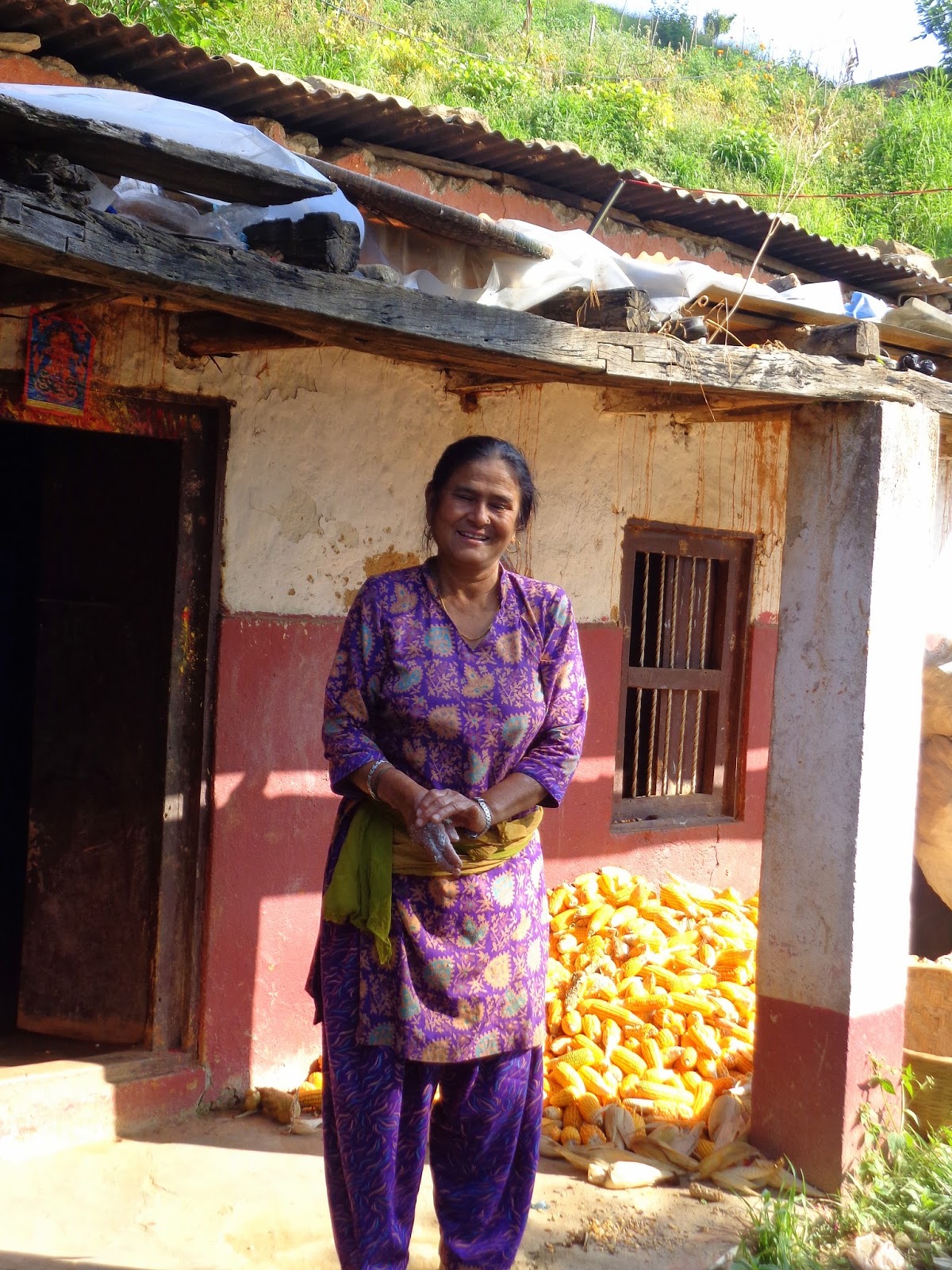
We spent our first few days in Nepal in a terraced countryside retreat that made up in charm what it lacked in convenience. It abutted a small, agricultural community and we visited the home of widow who had a huge heart which she opened to our group of eleven. Her home consisted of 3 small rooms with 5 foot ceilings. These houses have no chimneys and cooking is done inside the home. As you might guess, women who live in these constructs generally have lung problems before their 50th birthdays. All farm work in this area is done manually, but these folks are self-sufficient. We got to see them take their harvest to market during the feast of Dashain, a 15 day celebration that is the most important in Nepal.

The holiday near emptied Kathmandu and that allowed us to visit holy sites and stupas without rubbing elbows with masses of humanity. We also visited the funeral ghats where most Hindus are cremated. Death takes no holidays, so this was a busy area despite the Dashain celebration. I will share limited photos with you, as I know the process will be upsetting for some. Try to remember, this is part of their culture and it represents the promise of a better life to come. On a lighter note, many of you know that Nepal is a kick-off site for treks and Himalayan assents. I still get the giggles when I hear Sherpa guides speaking German or French. My bad! I just can't help myself.

Nepal is a country on the cusp. Once its hydroelectric power is harnessed and money flows to its coffers, the younger generation can look forward to a good life. It will be too late for those in their 40's and 50's. The infrastructure is near collapse, not because of the earthquake but because of neglect. If ever we are blessed with another visit to this country, I hope we will find it as thriving and vibrant as its neighbors. Wish you were here...Mary

Wednesday, October 21, 2015

Life at the Top of the World

After years of trying, we have finally reached Tibet, the rooftop of the world. The air in Lhasa is thin, and despite medication to prevent altitude sickness, many in our group were gasping for air as we moved from the plane to immigration control. The airport is about an hour from Lhasa proper, and the road to the city is banked by large complexes of vacant, newly built, mid-rise apartments. We could only guess they were the work of real estate speculators building in anticipation of an event that has yet to be announced. Lhasa, itself, is much as I imagined it to be. The streets are clean and colorful prayer flags fly from white washed buildings. Age seems to determine how people dress, with elders wearing traditional garments, while the younger people have adopted more western garb. While Tibet is a secular country, its citizens are profoundly devout and spinning prayer wheels and quiet chanting is the norm as folks move through the streets. The man who handled our luggage prayed as he moved suitcases from the coach to the hotel lobby. There are times of day when the incense that is burned is dense enough to make the eyes water. On a long term basis, I can only imagine what it would do to the lungs. The Dalai Lama is discussed only in historical perspective, although two of his palaces, actually monasteries, are as they were when he left the country. There are two principal palaces whose use was determined by the season. Winters at 12,000 feet can be bitterly cold, so the monks moved to lower climes as weather moved in. The Potala Palace, which is the seat of the Dalai Lama, is one of the most imposing structures I have ever seen. Guides take tourist up the 500 steps to the palace entrance. It sounds like a walk in the park, but believe me when I say it is not. The climb almost did me in and only determination got me to the monastery entrance. We also had the good fortune to spend time with nomadic farmers who opened their home, prayer room and kitchen to us. They lead simple spartan lives, but share what they have with their community and strangers who come their way. Until recently, the Tibetan diet was mainly meat based, but vegetables are slowly working their way to tables now under the influence of China and India. I must tell you that we had yak at all of our main meals. When it is well prepared, it tastes much like beef or buffalo. So, if you are looking for ways to cook yak, this blog is the place you want to be. We also had more than our fair share of butter tea. This is an acquired taste and while I find myself in situations where it is served, I haven't yet acquired that taste. The Tibetans are a gentle people who take no more from the earth than they need to survive. That principle of need is carried even into death. They refuse burial because they believe the land is for the living, not the dead. I could have spent several weeks here, but our schedule carries us on to Nepal. I will be posting more photos from Tibet on Facebook. Having been here for even a short time has been a blessing. Wish you were here...Mary
Related Posts with Thumbnails

Printfriendly