Showing posts with label tapas recipes. Show all posts

Friday, November 14, 2014

Tapas - Spanish-Style Garlic Chicken Wings


From the kitchen of One Perfect Bite...This is a simple recipe meant for those who enjoy chicken wings but would like to find a healthier way to prepare them. The wings are marinated and baked in a typically Spanish fashion and they are almost effortless to prepare, especially if you have your butcher break down the wings for you. The wings are at their best when allowed to marinate for eight hours or more before they go into the oven. They do not have the heat of Buffalo wings, but they are enormously flavorful and can be served with a hot sauce if that is more to your liking. I do hope you'll keep this recipe on your radar. Those of you who make the wings will not be disappointed. They would be great for a game day get-together. Here is how they are made.

Wednesday, November 12, 2014

Tapas Flamenco and Cookbooks


From the kitchen of One Perfect Bite...What do these pictures have in common? They capture a moment in time that I want to share with you. On the way to meet a cook who had graciously agreed to walk us through the basics of Spanish home cooking, the Silver Fox and I came across a band of gypsy troubadours performing the flamenco for onlookers in the town square. These squares are usually ringed with tapas bars and today's recipe is for a tapa that was being served at the time we stopped to watch and listen to the flamenco performance. The recipe and a recommendation for the books came later that day. I ordered the books you see as soon a we got home, and following their delivery this morning, I spent the better part of the day paging through them. Wow! Jose Pizarro is a chef and a restaurateur, and if you are at all interested in Spanish cooking, do try to get these books. I was able to purchase mine on Amazon at bargain basement prices, and I've already put together a list of recipes that I want to try. They are easy to follow, made with readily available ingredients and the photography perfectly captures the vibrancy of Spanish cooking. You can almost taste these dishes as you turn the pages. It is hard to duplicate Anthony Bourdain's Spanish experience in tourist hotels and restaurants, but books like these make it possible to create that experience in your own kitchen should you want to try.  I hope you'll stay tuned. Tonight's recipes, which come from a home cook, are for two frequently served tapas. Either of them makes a delightful mouthful, if, and it is a big if, you assemble them just before serving. They get soggy quickly, so do be forewarned. I personally love the pepper and anchovy combination, while the Silver Fox, who loves Manchego cheese, prefers the tomato version. I do hope you'll give them a try. If you enjoy bruschetta, I know you'll like these Spanish tostadas. Here is how they are made.

Tuesday, November 11, 2014

Tapas - Picantes Pimientos Asados (Spicy Roasted Peppers)


From the kitchen of One Perfect Bite...This is, arguably, one of the easiest of all tapas dishes to prepare. It has the added advantage of being one that can be made well ahead of serving and I really think you'll enjoy the Spanish version of roasted peppers. Because less vinegar is used in their preparation, the peppers are not as harsh as their Italian counterpart and I think you'll find many uses for them as you become more interested in Spanish cooking. In Spain, the peppers are charred over and open flame, and while many cooks use that methodology, I prefer to roast, not broil, peppers in the oven. It's a much cleaner way to blister them and it frees the hands for other tasks. Once skin, ribs and seeds have been removed, oven roasted peppers freeze well and the homemade variety is much cheaper than any commercial product you may find. I do hope you'll give this recipe and roasting technique a try. Here is how the tapas version of spicy roasted peppers are made.

Friday, November 7, 2014

Tapas - Chorizo Puffs


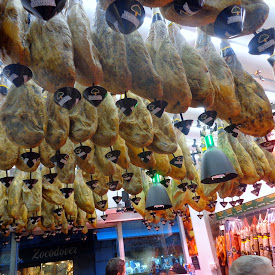
From the kitchen of One Perfect Bite...Pork is a mainstay of the Spanish diet. Roast suckling pig is a holiday favorite, and Iberico pork, which rivals Kobe beef in terms of cost and exclusivity, is favored by those who can afford to put it on the table. Those of more modest means can find pork legs hanging from racks in tapas bars and supermarkets and pork sausage, both sweet and hot, is also readily available. Spanish Chorizo, a cured, table ready pork sausage that's been seasoned with salt and smoked paprika (pimenton), is used extensively in Spanish cooking. It is unlike its Mexican counterpart and it is important to note that the two products cannot be used interchangeably. Chorizo is made in short or long and hard or soft varieties. Leaner varieties of the sausage can be eaten at room temperature and make a suitable tapas offering, while fattier versions are best used for cooking. Generally speaking, long thin chorizos are sweet and the short versions are spicy. Now here comes the rub. It is hard to find Spanish chorizo in American supermarkets. Keeping in mind that Mexican chorizo cannot be used in Spanish recipes, the dilemma becomes what to use as a substitute. Fortunately, Portuguese linguica and Italian pepperoni are both adequate, if not perfect, substitutes. Chorizo puffs are a tapas favorite and they can be made with choux paste or self-rising flour. I'm  featuring the latter version tonight, because I think they are more flavorful. The puffs are easy to make and delicious when served warm. They should be one-bite morsels, so watch the amount of of batter you use to form the mounds. A level tablespoon is perfect. I do hope you'll give this recipe a try. The combination of chorizo and manchego cheese is dynamite and I know you will enjoy the puffs. Here is how they are made.

Thursday, November 6, 2014

Tapas - Albondigas


From the kitchen of One Perfect Bite...I hope you appreciate whimsy. The origin of a Spanish tapa, a small snack that is served with drinks, is not really known. Legend has it that illness forced 13th century Castilian king Alfonso X - also known as Alfonso the Wise - to eat small snacks with the wine that had doctors had ordered to maintain his strength. After he recovered from the illness causing his weakness, he decreed that taverns serve food with beer or wine to keep the spirits from going too quickly to patrons heads. A more practical explanation is the use of a saucer or lid to keep dust or insects out of drink glasses. "Tapa" literally means lid and the first lid was probably a slab of bread or cheese placed over the glass in which wine or beer was served. A tapa can be anything from a potato fritter to a small portion of skewered meat, the only requirement is that it must be a small dish of something edible that is served with a drink. Tapa (one snack) or tapas (two or more snacks) should not be thought of as an appetizer or meal starter. If you start eating tapas, you do not stop until you are full. While many tapas can be served as a main course, the tapas portion is about 1/4 the size of an entree and it usually requires several of them to assuage hunger. Tapas are served in bars, not restaurants, and tapas bars are extremely popular in Spain. As family size has decreased, so, too, has the size of most Spanish homes, and space limitations have made it easier to socialize and entertain outside the home. Despite problems with the economy, the tapas culture in Spain is still vibrant and thriving. Albondigas appear on many tapas menus. You'll find these meatballs are a bit softer than their Italian cousins, but they are really good and the cinnamon scented sauce in which they braise is downright delicious. They have the added advantage of being relatively inexpensive and easy to make and I know you and your crew will love them. Here is how they are made.

Wednesday, November 5, 2014

Tapas - Roasted Potato Wedges with Chili Tomato Sauce


From the kitchen of One Perfect Bite...Spaniards love potatoes. French fries accompanied nearly every meal we had in Spain and roasted potatoes, in one form or another, appeared on all the tapas menus we encountered. The potatoes I'm featuring tonight are a mild version of the hot and spicy home fries called Patatas Bravas. I like to use the wedge shape because it is ideal for dipping and dunking and it is easier to serve as a tapas entry. The potato wedges can also be eaten without utensils and that makes them ideal tapas fare. I blanch the potatoes I use for this dish. It gives them a head start on the cooking process and allows me to use a higher heat to nicely brown and crisp the exterior of the potatoes without burning them. This is an extremely simple dish to make and it can be sauced to your personal taste. I prefer to use fresh chilies in the sauce, but red pepper flakes make an adequate substitute if fresh chilies are not available. While it is a matter of personal preference, I do not completely puree the chili tomato sauce. I like my sauce to have a bit of texture and the wedges are thick enough to handle it. I do hope you'll give this recipe a try. Here is how the potatoes are made.

Monday, November 3, 2014

Tapas - Pinchos Morunos (Spicy Pork Skewers)


From the kitchen of One Perfect Bite...How can you not love a country where the wine flows like a river at flood stage and you get to eat 5 times a day? Over the course of the next few days, it will become obvious that Spain, despite its flaws, has charmed me, and I've left a small piece of myself tucked in corners of its cities as I traveled across long stretches of the country. Food brings you here, so I promise I won't stray too far from our shared interest and I'll attempt to stay on point as I work through the foods and recipes I've brought back with me from Spain. A quick look at daily meal patterns is probably the best way to understand Spanish food preferences and how the country eats, so let's jump right in and get to it. The day in Spain begins with desayuno which is the first meal of the day. It consists of coffee and toast or a biscuit and it is usually eaten at home. Around 11 o'clock, the country breaks for the real breakfast, almorzando, which is served in coffee bars and restaurants throughout the country. It is a more substantial version of the early morning repast and might include pastry or a slice of tortilla, as well as juice and coffee. La comida is the main meal in the Spanish diet, similar to dinner in other countries, and takes place around two in the afternoon. It usually consists of several courses that include salad or soup, a main course and dessert. Still hungry? Merienda is basically an afternoon snack that consists of a sandwich or yogurt and some type of sweet bread or pastry. The final meal in the Spanish day is la cena, or dinner. Dinner in Spain is lighter than la comida but can also consist of multiple courses and it has contributed to the growth of the tapas culture in Spain. Traditionally, the meal takes places around ten in the evening and tapas bars hum at this time of night. For the record, a tapa is a small dish of something edible. While it can be as simple as a small plate of olives, tapas have an extraordinary range of complexity and expense. With the help of some friends in-country, I have been able to find some truly wonderful tapas offerings and will be sharing them with you for the remainder of this week. I wanted to start with one of my favorites. I know you will love these pork skewers. Here is how they are made.

Related Posts with Thumbnails

Printfriendly