Showing posts with label japanese. Show all posts

Friday, April 4, 2014

Frugal Foodie Friday - Chicken Karaage (Japanese Fried Chicken)


From the kitchen of One Perfect Bite...I don't often serve deep fried foods, but when I do no holds are barred. I was introduced to Karaage Chicken four decades ago, and it was a case of love at first bite. The salty marinade and crisp crust for which this dish is famous makes for an unforgettable taste treat. The chicken is inexpensive to make, easy to prepare and guaranteed to make your socks go up and down as long as you keep a couple of things in mind. Cornstarch is absolutely necessary to the success of this dish. Flour simply will not produce the crispy crust that has made this chicken famous. It is equally important to keep the temperature of your oil constant. Don't overcrowd your fryer and make sure to bring it back to temperature before frying the next batch. Quickly drain the chicken and get it to the table while it is hot. That constraint makes it next to impossible to serve this dish to guests, but friends and family are fair game and will love you for your effort and the introduction to this dish. You'll find that lemon adds enormous flavor to the chicken and helps to keep the saltiness of the soy sauce in check. These days I actually use a low-sodium sauce to make the marinade, but I urge those of you who have access to tamari to use it instead. Japanese tamari is thicker, richer, and less salty than most soy sauce and it is wonderful in this marinade. Because the dish is made with chicken thighs it is inexpensive to make and well within the reach of most budget conscious cooks. I love chicken prepared in this manner and I highly recommend it to all of you. Here is how it is made.

Friday, May 10, 2013

Frugal Foodie Friday - Japanese-Style Chicken Drumsticks


My Thought for the Day can be found, here. If you like it, please let us know with an official  thumbs up.

The Discovery Fit and Health website has included One Perfect Bite in the Chilled Soup and Summer Salads link of their round-up, 7 Low-Calorie Summer Recipes. You can find the complete feature, here.  Try not to miss it. It contains some great recipes and  you'll enjoy the time you spend there.


From the kitchen of One Perfect Bite...This week's Frugal Foodie Friday feature is the first in a series of posts that will explore ways to use inexpensive chicken parts. Not to worry, I'm talkin' chicken drumsticks, not innards or parts with odd sounding names and slippery surfaces. For reasons I don't fully understand, the cost of drumsticks has not inflated as quickly as other chicken parts and they remain a bargain, even when not on sale. Tonight's recipe comes from Food.com where it has it's called, Japanese Mum's Chicken. Chicken prepared in this manner is very popular in Japanese homes and there are as many versions of this recipe as there are Japanese moms to cook it. This recipe, though simple, is exceptional, but it contains one ingredient that is beyond the reach of those with truly limited food budgets. Balsamic vinegar is expensive and its cost could feed a family of four for at least two nights. I have found a way around that with a simple substitute that is workable in this recipe and others like it. If you combine a tablespoon of apple cider or red wine vinegar with a 1/2 teaspoon of sugar you have a reasonable substitute for balsamic vinegar. In the recipe below, a mix of 1/2 cup vinegar with 4 teaspoons sugar will give you a sufficient quantity of poor man's vinegar to make this recipe workable. This method of cooking and the marinade in which the drumsticks cook works well for chicken wings as well. This recipe is fast, easy and inexpensive. It is also delicious. I hope you will enjoy it. Here's the recipe.

Japanese-Style Chicken Drumsticks...from the kitchen of One Perfect Bite courtesy of Food.com

Ingredients:
8 chicken drumsticks, skin on
1 cup water
1/2 cup balsamic vinegar
1/3 cup soy sauce
2-1/2 tablespoons sugar
1 garlic clove, peeled and bruised
1 small hot chili pepper, slit open, seeds removed

Directions:

1) Place all ingredients (chicken through chili) in a deep skillet and bring contents to a boil. Reduce heat and simmer, spooning off surface scum as needed, for about 20 minutes.
2) Increase heat, turning drumsticks frequently, and cook until liquid has reduced to a sticky glaze, about10 minutes longer.
3) Arrange chicken on a serving platter, remove garlic clove and chili from the liquid, then spoon remainder of glaze over chicken. Serve immediately. Yield: 4 servings.


One Year Ago Today: Pork Parmesan with Spaghetti


Two Years Ago Today: Strawberry Sorbet


Three Years Ago Today:  Fusilli with Walnut and Garlic Sauce


Four Years Ago Today: Eggs Florentine

Tuesday, August 21, 2012

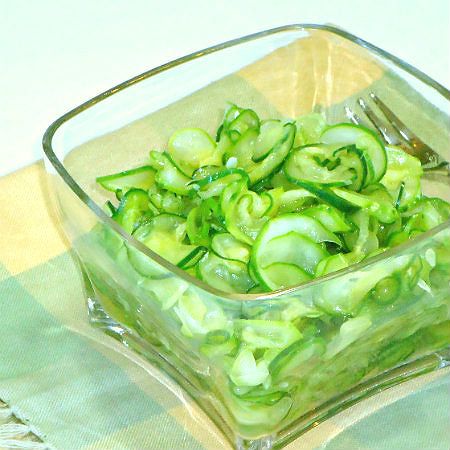
Japanese Cucumber Pickles


From the kitchen of One Perfect Bite...I love crisp pickles and the storage fridge in our garage almost always holds a quart or two of my favorite quick-fix dills. Kirby cucumbers were available at all the markets this weekend, so my project for the morning was to replenish our stash while the cucumbers were plentiful. For as much as I love pickles, I only make them when special varieties of cucumbers are available. In theory, pickles can be made with any cucumber, but I prefer to use varieties specifically developed for brining because their skins are less bitter and they contain fewer seeds. It's a "princess and the pea" thing. While I was making the dills, I also put together a quick Japanese pickle that I use as a relish for chicken or turkey burgers. Pickles are common throughout Asia and the gentle heat of this wasabi flavored pickle is especially popular in Japan. The pickle is mildly hot and more thinly sliced than most Western-Style pickles. Because I planned to use them as a crisp substitute for relish, I used a mandoline to slice mine paper thin. These pickles are extraordinarily easy to make and they are delicious addition to meals that center on grilled meat. The wasabi powder can be found in any Asian grocery and it is also available online. The good news is that once you have it it will last forever. This recipe is really simple but it will produce a wonderfully crisp and delicious pickle.  Try to use the pickles within a day of making them. They lose color if they sit for too long a time. That caveat aside, I hope you will give the recipe a try. Here's how the pickles are made.


Japanese Cucumber Pickles...from the kitchen of One Perfect Bite courtesy of Maggie Ruggiero and Gourmet Magazine

Ingredients:
1 pound Japanese or Kirby cucumbers (about 5)
1/2 teaspoon wasabi powder
1/2 teaspoon water
2 tablespoons rice vinegar (not seasoned)
1 tablespoon sugar
1/4 teaspoon soy sauce

Directions:
1) Very thinly slice cucumbers crosswise with slicer; toss with 1 teaspoon salt and drain in a colander 15 minutes. Rinse cucumbers under cold water, then squeeze handfuls to remove excess water; pat dry.
2) Stir together wasabi powder and water in a bowl and let stand 5 minutes. Add vinegar, sugar, and soy sauce, whisking until sugar has dissolved. Add cucumbers and toss well. Yield: 6 servings.


One Year Ago Today: French Lemon Tart and  Pate Sablee


Two Years Ago Today: Grapefruit Sorbet


Three years Ago Today: Swedish Meatballs


Wednesday, December 15, 2010

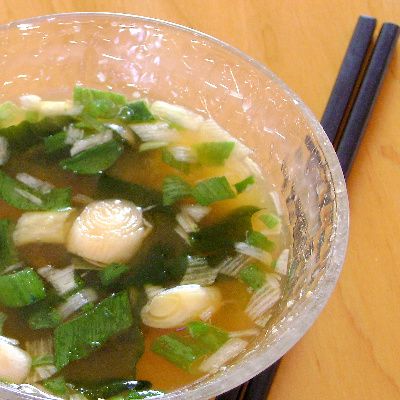
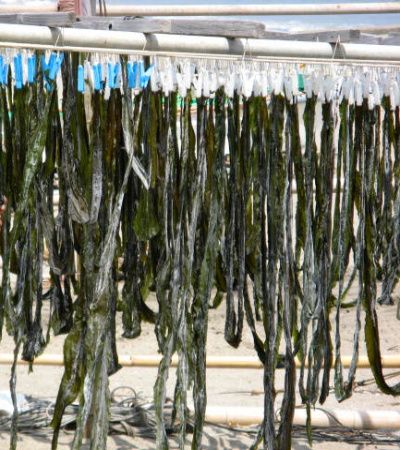
Miso Soup + Seaweed Harvest for Outdoor Wedensday


"Tis the season to be jolly...." True, but wretched excess robs the body of strength and the mind of clarity. That's scary because the holiday season has only just begun and weeks of revelry remain before the firm resolve of the New Year kicks in. Eating sensibly can be difficult and its hard to find nutritional balance on holiday tables. Truth be told, I don't always look for balance, but I do watch what I eat. It's not a diet in the true sense of the word, but when I know dinner will be heavy, lunch will be light, sometimes very light. While I know there are celebrities who advocate regimes of fast and purge, that's not my style. I have to eat something. My something can be light and the portion can be small but it has to be there or my inner diva surfaces. Even I don't like her much. To keep her quiet, I made miso soup for lunch today. In Japan miso soup is a culinary staple. It is very light and usually served at the beginning of a meal. The soup, developed by Buddhist monks in the 7th century, was a favorite of Samurai warriors who chose it for its nutritional content. It is still a favorite in Japan today where it is called misoshiru. The soup is made with a stock called dashi and a soft miso paste. Other ingredients can be added according to whim or availability. Miso paste is made from a mixture of soybeans, a starch such as rice or barley, salt, a smidge of water and yeast. Fortunately, miso paste can be found in most large grocery stores. It comes in four forms: red, white, barley, and soybean. I use a commercially available white miso to make my soup. Unfortunately, I have to make my own dashi. While that's not hard to do, it requires some forethought and advanced planning. When I make it, I make lots and freeze it. If you are unable to get the ingredients for dashi, a vegetable or chicken broth can be used. I add very little else to my soup. I usually settle on a handful of green onions, some Wakame seaweed and tofu. While it is not necessary, I add tofu to "beef" up the protein content of my soup.


Wakame is an edible seaweed that can be farmed or harvested from the ocean. It is high in nutrients and low in fat and cholesterol and, when fresh, is a glorious leafy green in color. I have no access to fresh Wakame, so, I use a dried, dehydrated form. Today's recipe is a two step procedure. The first recipe is for dashi, a Japanese fish stock. The second is for the soup itself. I know it's hard to make something from scratch when dehydrated packets of it are available in grocery stores. I make my own to keep a handle on the sodium content of my soup. I hope you'll give this version a try. Here are the two recipes.


Dashi - Japanese Fish Stock

Ingredients:

4 cups cold water
1 (6-inch) piece konbu (edible kelp), cut into 2-inch pieces
1/3 cup bonito flakes (bonito is a member of the mackeral family)

Directions:
Put water and konbu in a pan. Let konbu soak for 20 minutes. Bring to a boil over medium heat. Stir in bonito flakes and remove from heat. Let sit for at least 10 minutes. Press and strain through a fine mesh sieve. Yield: 4 cups.

Miso Soup

Ingredients:
4 cups hot dashi (see above)
1/3 cup miso paste
1/3 cup sliced green onions
1 cup medium-firm tofu
2-1/2 tablespoons pre-soaked Wakame seaweed

Directions:
Bring miso to a simmer. Slowly spoon miso paste into soup. Do not boil. Stir in softened Wakame, green onions and tofu. Serve hot: Yield: 4 cups.

You might also enjoy these recipes:
Japanese Clear Soup with Carrots and Daikon Flowers - Kahakai Kitchen
Nabeyaki Udon - Tasty Trix
Vegetable Wonton Soup - Seriously Soupy
Soba Noodle Soup - The Hunger Struck
Chinese Egg Drop Soup - Curious Eats
Tom Yum Goong - Las Vegas Food Adventures

This is being linked to:
Outdoor Wednesday - A Southern Daydreamer

Wednesday, February 3, 2010

Miso Chicken - Shades of Gray - Outdoor Wednesday


A perfect dish to ward off the damp and creeping fog.


The ridgeline seen from my kitchen window.


Cannon Beach on the Oregon coast.


London in winter fog.


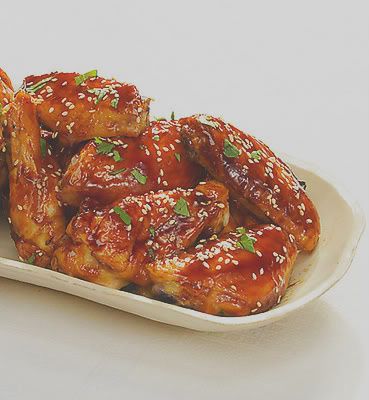
From the kitchen of One Perfect Bite... This chicken is one of my secret weapons. I make it once or twice a year, usually in the winter, to lift spirits and mellow the steely gray of the Oregon winter sky. The chicken is really easy to do and you can find all the ingredients you need to make it in any large grocery store. Chicken wings cooked in this fashion would be perfect for game day. While I grilled these, they can also be baked in a 400 degree oven for 30 minutes or so. Mirin is, for the most part, a cooking wine, though it can be served as a drink for ceremonial purposes during new year celebrations. Its composition is 40 to 50 % sugar, so basting marinades made with it must be watched, lest they burn. It is very similar in taste to sake, though it has a lower alcohol content. Interestingly enough, it can be made at home. Miso is a condiment of fermented soy bean paste that can be used to add a unique flavor to marinades and basting sauces. Used in conjunction with mirin, it can help overcome really strong flavors. It, too, can be made at home. Maybe I'll put them on my bucket list. Maybe. Here's the recipe I use for wings or thighs. I actually prefer thighs, but I must admit that wings make better party food.

Miso Chicken ...from the kitchen of One Perfect Bite

Ingredients:
1/2 cup soy sauce
1 cup mirin or 1/2 cup mirin + 1/2 cup sake
1/2 cup light miso
4 scallions, thinly sliced
2 teaspoon freshly grated ginger
2 teaspoon minced garlic
8 (about 2-lbs.) boneless chicken thighs or 20-24 (about 3-lbs) chicken wings
1 teaspoon toasted sesame seeds

Directions:
1) Combine soy sauce, mirin, miso, onions, ginger and garlic in a small bowl. Divide marinade into 2 parts. Pour half into in a one-gallon zip-lock bag. Shake to mix well. Add chicken pieces and coat well. Refrigerate for about 3 hours, shaking bag several times. Refrigerate reserved marinade.
2) Preheat grill to very hot or oven to 400 degrees F.
3) Remove chicken from marinade and pat dry with paper towels.
4) If grilling, cook for 5 minutes, turn and continue grilling until brown and cooked through, about 5 minutes. Brush chicken pieces with reserved marinade.
5) If baking, arrange chicken pieces in a single layer on a large rack set over a baking pan. Cook for 30 minutes. Brush with reserved marinade.
6) Transfer chicken to a serving platter and sprinkle with toasted sesame seeds. Yield: 4 to 6 servings.

This is being linked to:
Outdoor Wednesday - A Southern Daydreamer

Photos of the Oregon coast and London in the fog are printed via terms of Creative Commons licensing.

Tuesday, February 2, 2010

Warm Asian-Style Rice Salad


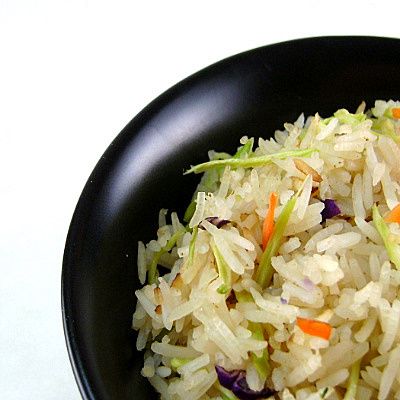
From the kitchen of One Perfect Bite...I made a new rice dish to serve with miso chicken tonight. I decided to grill despite the rain, so, if you happened down our stretch of highway this evening, I would be the fool you saw manning the grill beneath that huge red golf umbrella. Miso chicken is delicious, but I'm always puzzled by what to serve with it. Summer is no problem. I make a Japanese potato salad that's a perfect compliment to the chicken. Winter is more problematic. Plain, unflavored rice simply will not do and my winter palate refuses to embrace mayonnaise based salads. So, I decided to combine hot rice with mirin wine and broccoli slaw and see what happened. In Japan, sweet rice would be used to make a dish like this. Despite its name, this rice isn't sweet and it doesn't contain gluten. It is, instead, a very sticky, short-grain rice that's used to make sushi or sweet rice desserts. As you can see, I used basmati rice to make mine. It works well, but would be difficult to eat with chopsticks because the grains do not clump. I made enough rice to feed four, but the ingredients here can easily be doubled. I used mirin, a rice wine, because I think it's less sweet than sake and is more to our taste. The rice must be hot when the mirin and vegetables are folded into it. This is a really, really easy to make and it's quite good. Here's the recipe.

Warm Asian-Style Rice Salad...from the kitchen of One Perfect Bite

Ingredients:

2 cups hot cooked rice
6 tablespoons mirin cooking wine
1-1/2 cups broccoli or cabbage slaw
Salt and pepper to taste

Directions:
Fold mirin and broccoli slaw into hot rice. Mix well. Cover pot and let sit for 15 minutes, or until mirin is absorbed. Season to taste with salt and pepper. Toss. Transfer to rice bowls. Yield: 4 servings.

Tuesday, February 3, 2009

Gyoza - Japanese Dumplings for Zachary


Zachary, my oldest grandson, loves dumplings. Zach is a budding gourmet and he's no slouch in the kitchen. A while back, he found a recipe for dumplings and, in pursuit of a Scouting merit badge, decided he would make them. Trouble was he picked a recipe without a picture. He was discombobulated when the recipe for chicken and dumplings didn't produce the kind of dumpling he expected. It was a classic case of FTCM (family shorthand for Failure To Consult Mom). Zach's favorite dumpling is the Japanese gyoza and he just can't get enough of them. During our last visit Zach had dumplings three nights running. The number he consumed is a secret that I'll take with me to the grave. This past week was a really good one for my grandguy. He made the honor roll and finished second in a spelling bee that was really important to him. If I lived nearby we'd celebrate the occasion with a platter of gyoza. This recipe is the next best thing - he can make these himself but only when Mom says he can. It's not necessary to pleat the dumplings. You must, however, have a good seal, so resist the temptation to overstuff them and keep the edges of the wrappers really clean. The dumplings can be steamed or fried - we steam them. Gyoza wrappers can be purchased at the grocery store. They are thinner at the edges than the more conventional dumpling wrappers. If you'd like to see how gyoza are pleated go here. There is also an inexpensive mold that can be used to form them. I like the mold. So, big guy, you are set to go! Tell Drew we'll do carbonara in March. Almost forgot..... the word for today is Sawatdi. Hugs...Oma.


Gyoza

Ingredients:
Dumplings:
1/3 cup chopped cabbage (blanched)
2 tablespoons chopped scallions
1/2 pound ground pork
1 teaspoon dark sesame oil
1 teaspoon sugar
2 teaspoons soy sauce
1 teaspoon minced fresh garlic (about 1 clove)
1 teaspoon minced fresh ginger
20 gyoza wrappers

Dipping sauce:
1/3 cup soy sauce
1/3 cup rice wine vinegar
1/3 cup chopped scallions
1 teaspoon dark sesame oil
1 tablespoon sriracha or sambal

Directions:
1) Combine all ingredients except wrappers in a bowl and mix well.
2) Place a teaspoonful of filling in a gyoza wrapper and using a finger lightly dampen edges. Fold to form a semicircle, gathering the front side of wrapper and pressing to seal top.
3) Place gyoza in top of a bamboo steamer placed over boiling water. Cover and steam for 5 minutes.
4) Meanwhile, combine soy sauce, vinegar, scallions, sesame oil and sriracha in a bowl and whisk to combine.
5) Serve dumplings dipping sauce. Yield: 20 gyoza to serve 4.

The dipping sauce comes from a recipe by my friend Lily Ng whose blog Lily's Wai Sek Hong has some of the best Asian recipes I've encountered on the internet.
Related Posts with Thumbnails

Printfriendly